

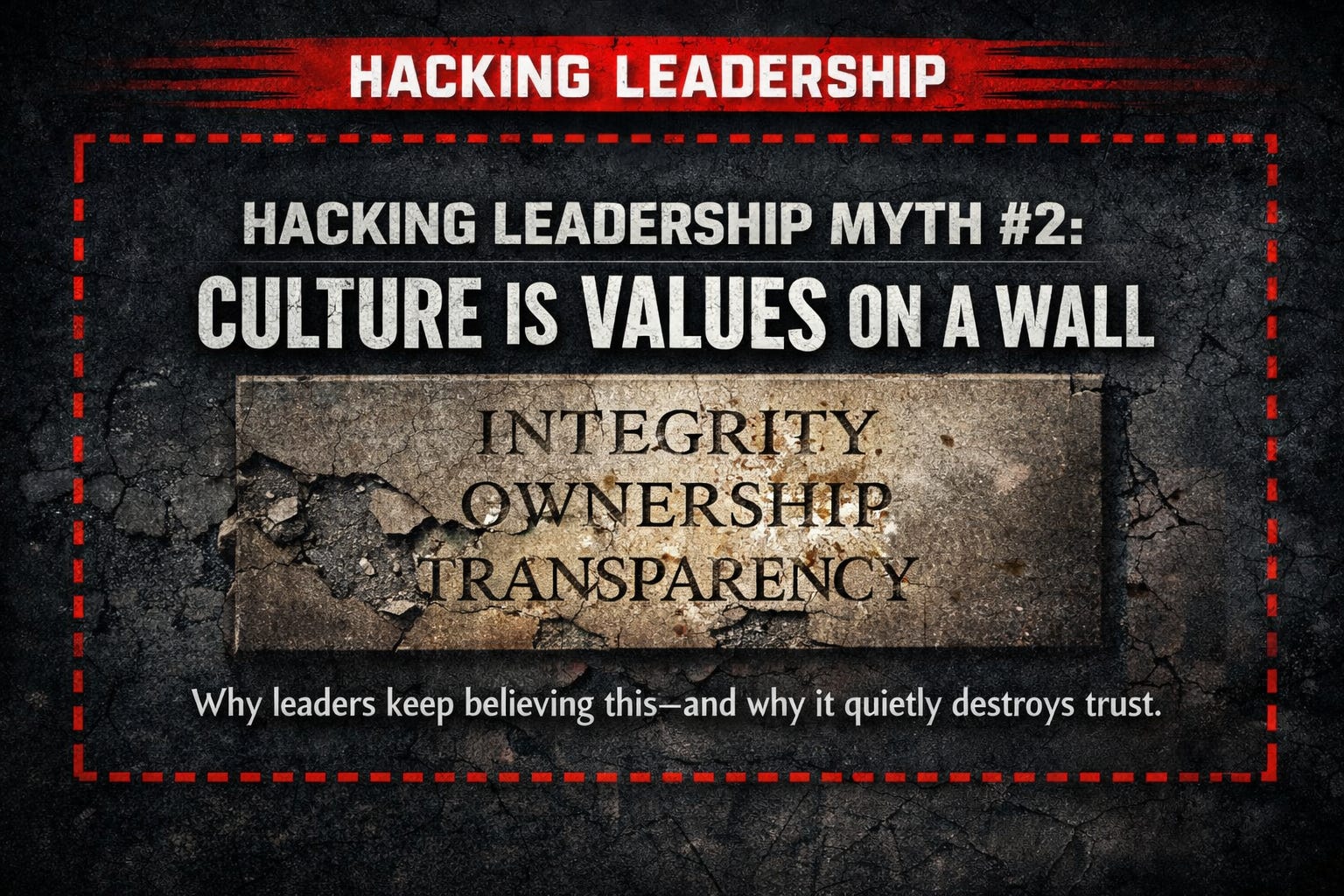
Hacking Leadership Myth #2: Culture Is Values on a Wall
Why leaders keep believing this, and why it quietly destroys trust
Every company says culture matters. Most of them even mean it.
So they write values. They socialize them. They repeat them in all-hands and onboarding decks. They print them large enough to be seen from across the office.
And then they’re confused when nothing changes.
The underlying belief is simple and reassuring: if leaders define values clearly enough, culture will follow. The words will do the work. Alignment will emerge. Behavior will adjust.
It rarely does.
Culture is not what an organization says it believes. Culture is what actually happens when belief and convenience collide. It shows up in promotions, exceptions, tradeoffs, and silence. It is formed by what leadership rewards, what it tolerates, and what it looks away from when results are on the line.
Values on a wall don’t shape behavior. Incentives do. Consequences do. Power does.
Employees understand this instinctively. They don’t study value statements to figure out how to behave. They watch who gets promoted, who gets protected, and who pays a price for crossing a line. They notice when stated values bend for high performers and disappear under pressure.
That’s when trust erodes. Not because leaders lied, but because their decisions told a different story.
This myth survives because values-as-culture feels productive without being threatening. Leaders can declare intent without confronting hard choices. They can point to words instead of enforcing standards. They can believe culture is being addressed without changing how power actually operates.
But culture doesn’t respond to language. It responds to enforcement.
If your best performers can violate your stated values without consequence, those values are fiction. If managers are rewarded for outcomes but not for how they achieve them, your culture has already been defined. And no amount of better wording will fix a system that rewards the opposite behavior.
Culture isn’t communicated. It’s enforced.
Until leadership decisions align with declared values—especially when it’s uncomfortable—the wall is just decoration.