

Structural Recap
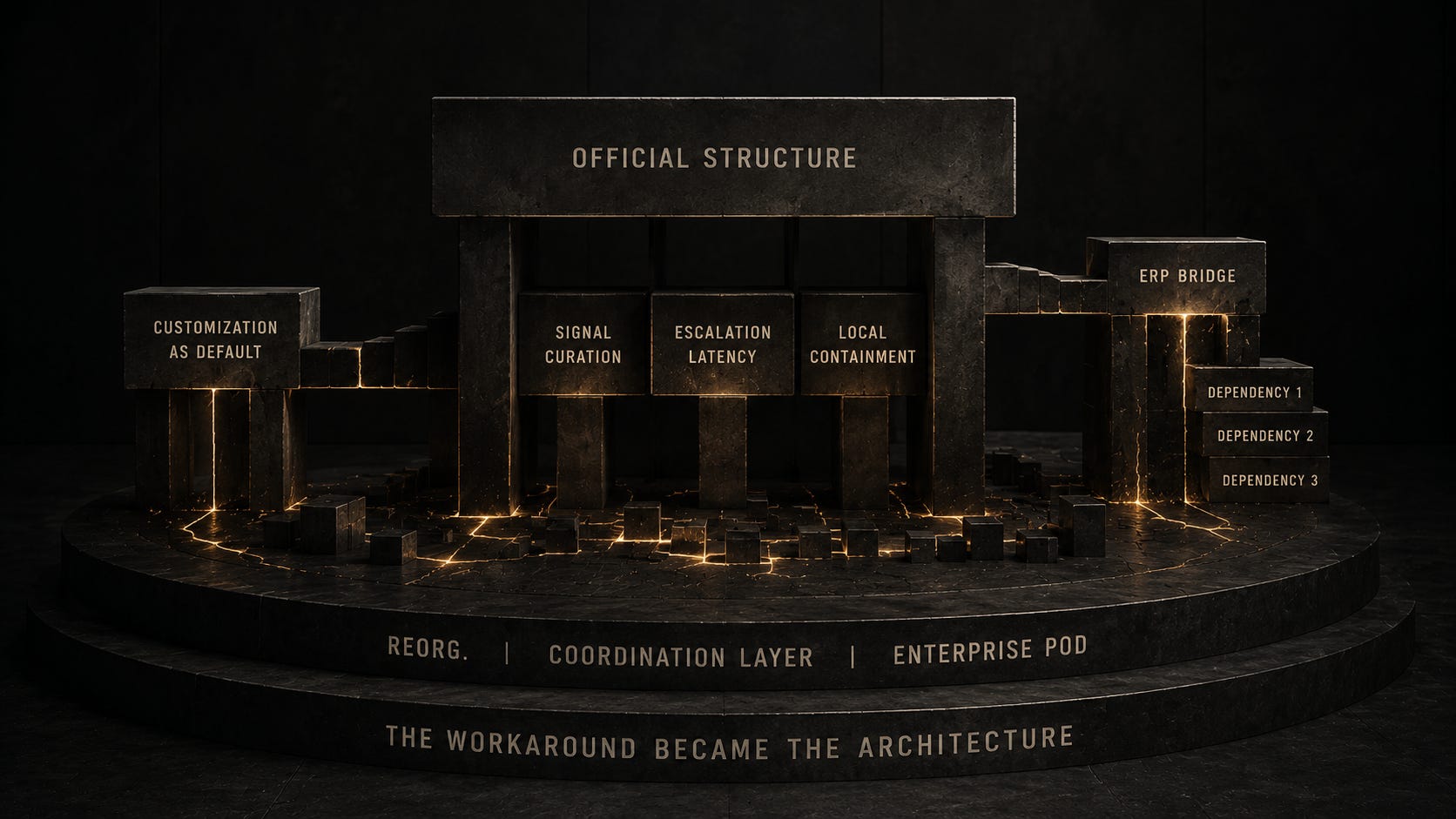
By month 9, Northstar’s temporary fixes have stopped being temporary, without anyone deciding they were permanent. The ERP bridge that was going to be retired in 18 months is three dependencies deep and effectively unremovable. The containment behavior from Part I has become how work routes. The curated reporting from Part II has become the format. None of this was adopted as policy. The organization wore grooves, and grooves are policy no one has to enforce.
Then a volatility event, an enterprise outage, prompts a reorg. The CEO restructures competently and around what the company has become rather than the standard it drifted from. The new coordination layer gives the slow escalation an official home. The enterprise pod puts customization-as-default into the org chart. Centralized decisions pull authority toward the leader at the moment his signal is most compressed. Every move is defensible, and every move pours concrete around the drift.
What is compounding is irreversibility. In Part I each distortion was a behavior correctable by a decision. By month 9 each has acquired an owner, a budget, a headcount, or a dependency graph defending it. The reorg also delivers a real improvement, which the system reads as proof it was right, the canonical trap of external success arriving while structure degrades and the win wrapping the wrong lesson.
Distortion Model (Causal Map)
TRIGGER: A temporary workaround works. Things that work get built on (the ERP bridge; the containment routing; the curated format).
↓
BEHAVIORAL SHIFT: Reasonable people reuse the working thing, each for a sound local reason. Reuse accumulates into dependency. Degradation is tolerated, then normalized, then reinterpreted as “just how we operate.”
↓
REINFORCEMENT: A volatility event prompts a reorg. The new structure is built around the adapted behavior, not the standard. Drift acquires owners, budgets, headcount, dependency graphs. The reorg improves the metric that prompted it, validating the wrong pattern.
↓
METRIC MOVEMENT: Cost changes CHARACTER, not just magnitude: escalation latency is no longer a number that drifted, it is the designed path. Customization is a pod’s mandate. The bridge is unremovable without a funded project.
↓
ENTRENCHMENT: Correction now costs someone’s mandate, team, or an unplanned project. The thing to be corrected is no longer behavior. It is the architecture the behavior hardened into, and architecture does not yield to a conversation.
The causal root is unacknowledged hardening: temporary things accreting dependencies with no decision point and no owner accountable for the “temporary” label still being true. The instrument forces the acknowledgment and the decision the drift was structured to avoid.
The recognition above is the public half. What follows is the instrument: how to inventory hardened workarounds, separate real infrastructure from unacknowledged debt, test whether a reorg corrects drift or concretes it, and the 30-day sequence to decide.
