

Law XII: Confront Degradation
Standards don’t collapse. They erode, one accepted explanation at a time.
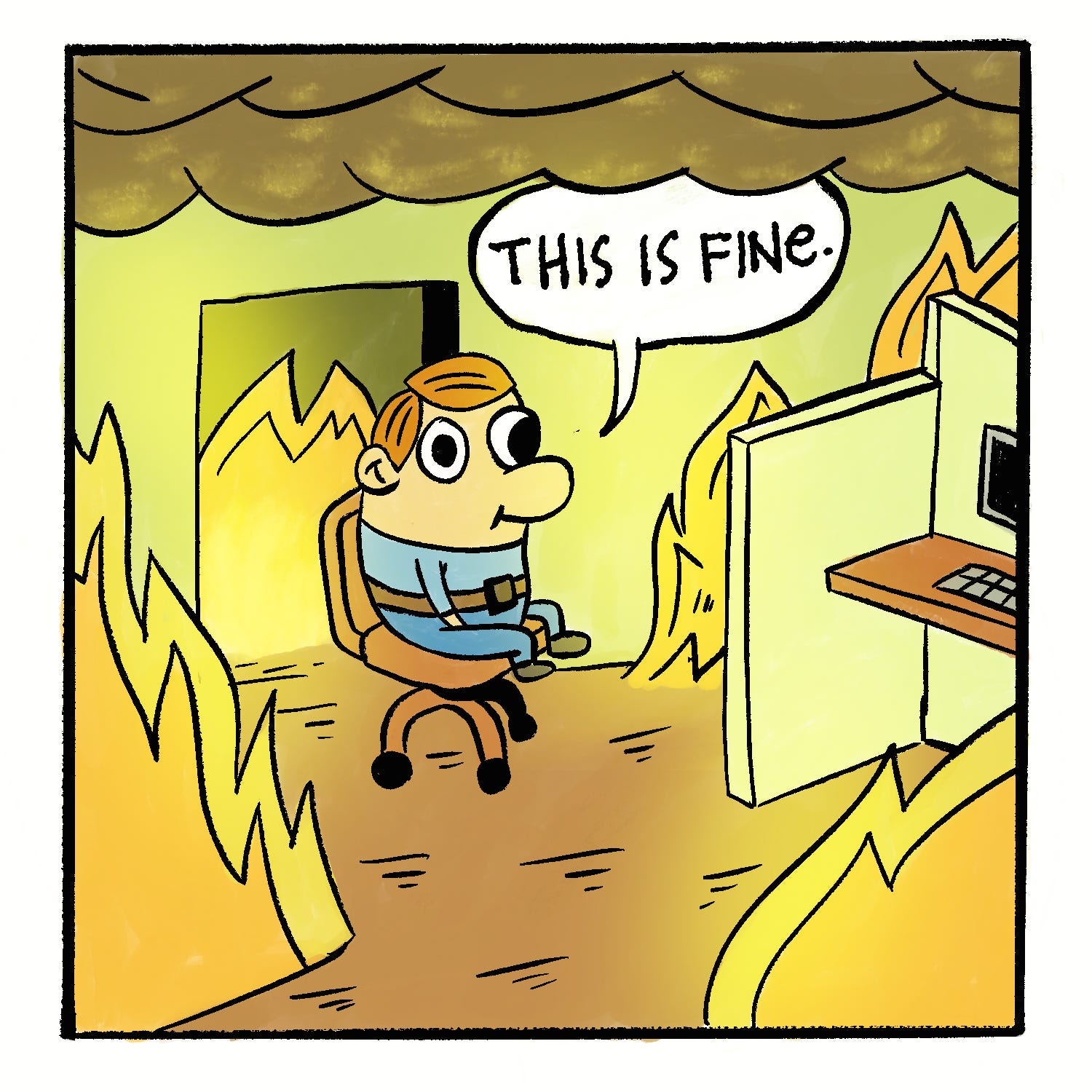
There is a leader who confronts the first compromise when it is still one compromise.
The missed commitment gets named. Not prosecuted, named. The explanation is heard and the standard is held anyway. The conversation is uncomfortable for about fifteen minutes. The team watches. What they read from it isn’t harshness. It’s that the floor doesn’t move. And a floor that doesn’t move is what makes everything else possible; the delegation, the autonomy, the trust that authority has been distributed to the right people. None of that works on a surface that shifts.
That leader doesn’t avoid difficult conversations. They have them while the conversations are still small.
Then there is the moment almost every leader has been in. A commitment is missed. An explanation is offered. The explanation isn’t particularly good, but confronting it would cost more than absorbing it. The timing isn’t right. The relationship needs protecting. The disruption isn’t worth it for one instance. So the explanation is accepted.
That moment is not neutral.
The system reads acceptance as signal. Not as restraint, not as grace, not as strategic patience. As approval. The standard didn’t just soften in that moment, it moved. And it moved without announcement, without intent, without anyone deciding it should move. The leader didn’t let something go. They communicated, with more clarity than any memo, that the standard is negotiable.
The next instance is a little easier to absorb. And the one after that.
Degradation rarely takes hold through dramatic collapse. It advances through tolerance.
It begins with small compromises that appear reasonable in isolation. Language softens. Updates become filtered. Missed commitments are excused rather than corrected. Minor underperformance is rationalized instead of addressed. Each instance can be defended in the moment. Over time, they accumulate and reinforce one another.
When degradation is not confronted immediately, it normalizes. Once normalized, it becomes harder to detect because expectations have already shifted. Standards adjust quietly. Distortion increases because weak judgment produces weak signals, weak decisions, and inconsistent execution.
What is repeatedly tolerated becomes embedded. What is ignored is approved. The system, and the people within it, will adapt whether you intend it or not.
This applies to mediocrity, but it is not limited to mediocrity. It applies to lies, to ego-protective narratives, to filtered reporting, to avoidance of difficult conversations. A lie that goes unchallenged becomes part of the organization’s operating story. A missed commitment that is not addressed becomes precedent. A softened metric becomes the new baseline.
Culture-building frameworks treat this as a problem of norms and values: if the culture is strong enough, people will self-correct toward the standard. That argument has surface plausibility. What it cannot account for is the incentive structure that makes tolerating degradation rational. Confronting degradation carries immediate cost: the difficult conversation, the political friction, the disruption of apparent stability. Not confronting it defers that cost while allowing degradation to compound quietly. A strong culture does not change that calculation. What changes it is consistent structural consequence — enforcement that makes tolerance more costly than correction. That is the mechanism this Law defines. Culture is the output of that enforcement, not the substitute for it.
Over time, the system resets around whatever it tolerates.
As that reset occurs, internal reference points erode. Feedback weakens. Accountability softens. Incentives adjust. Behavior follows those adjustments. This is the Meta-Law — the Doctrine’s foundational principle that incentives govern behavior, always — not through intentional design, but through accumulated inaction. The Meta-Law does not negotiate. Behavior conforms to the incentive structure in place, whether leaders acknowledge it or not.
At that stage, degradation is no longer episodic. It is structural.
Correction becomes harder because the system has reorganized itself around the lower standard. Those who benefited from relaxed expectations resist change. Incentives that adapted to distortion resist recalibration. The Cascade — the Doctrine’s framework for how dysfunction embeds and hardens across five progressive stages — no longer requires fresh violations to accelerate. It now runs on accumulated tolerance.
Hiring decisions are one of the fastest accelerants of this process. A bad hire always hurts. The damage may be visible through missed targets or poor decisions, or it may be subtle through weakened standards and tolerance for imprecision. Weak judgment spreads through shared decisions. Lower expectations normalize through daily interaction. The secondary damage is often greater than the primary mistake.
When a team recognizes that someone is operating below standard and leadership does nothing, that inaction becomes a signal. It communicates that standards are flexible, that performance is negotiable, that degradation is acceptable. In that moment, the issue ceases to be individual and becomes systemic.
Confronting degradation does not mean hiring only finished products. Every high performer was once inexperienced. The distinction that matters is not tenure, rather it is the difference between lack of experience and lack of standard. Inexperienced people with high standards and a genuine capacity to improve strengthen the system over time. Experienced people with weak judgment degrade it immediately. One is a development question. The other is a structural one.
Confronting degradation is not cultural preference. It is structural necessity.
If degradation is not confronted, it will be absorbed. If it is absorbed, it will become standard. And once a lower standard becomes architecture, restoring it will not require encouragement.
It will require force.
The system will always become what it tolerates.
Law XII closes the third structural layer of the Doctrine of Organizational Physics — Execution and Entropy Control — and with it, the complete Doctrine rollout. Twelve Laws. Three layers. One system governing why organizations produce the outcomes they do, independent of intent, character, or culture.
But completion is not the destination, it is simply the foundation.
What the full system now makes possible — the applied architecture, the live case work, the structural diagnosis of organizations at scale — is the subject of what comes next. The synthesis post following this Law takes that on directly. It is not a summary of what you’ve read. It is a demonstration of what you can now see.
The Operator Insight paired with this Law addresses the applied layer: how to read the current state of degradation in your system before the pattern becomes permanent, what the early signals look like before normalization is complete, and what confrontation actually requires structurally versus what it requires personally. The question this post raises isn’t whether tolerance is running in your system. It is. The question is where — and whether you can still name the first compromise that moved the standard.