

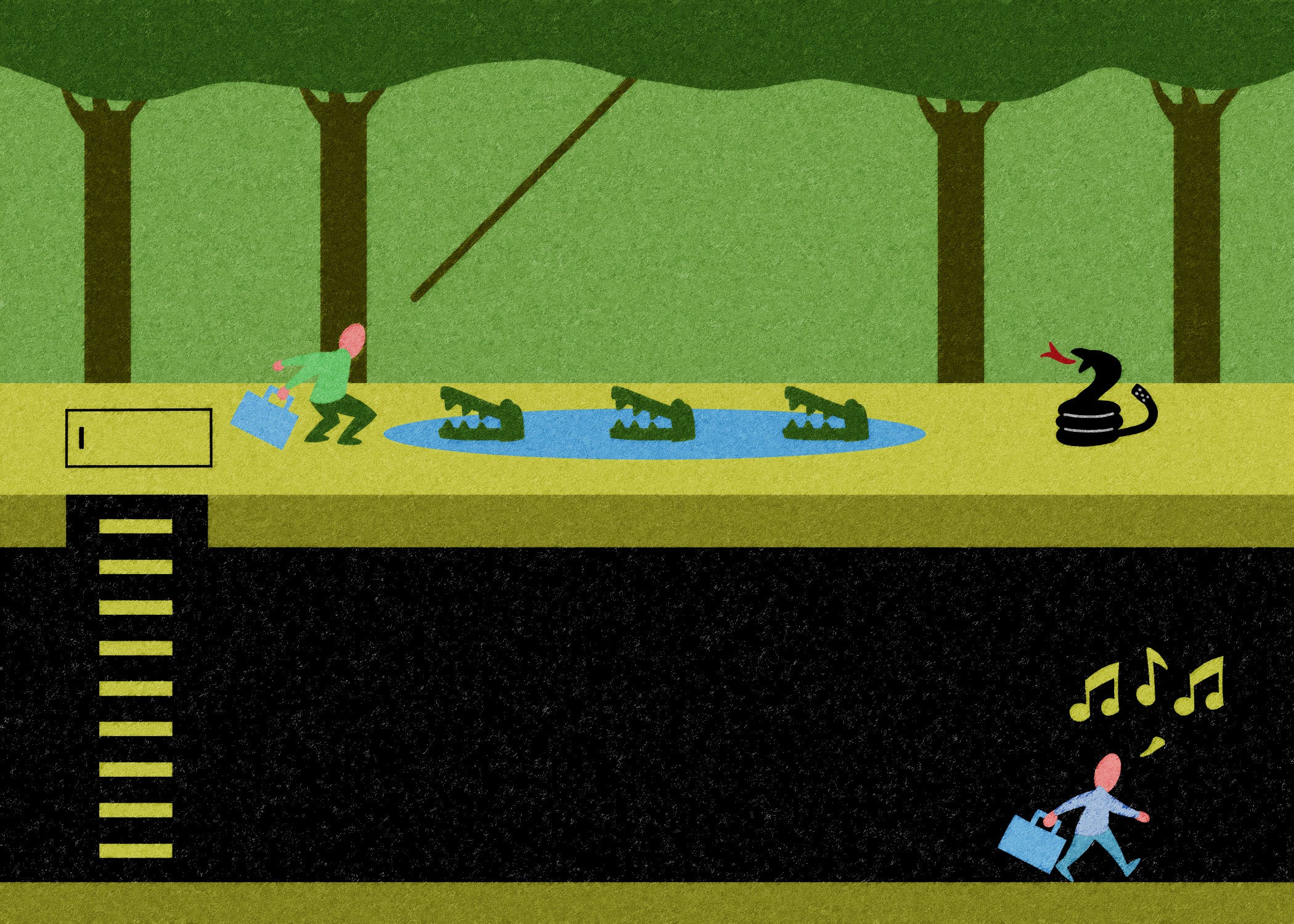
You hired someone excellent. They are experienced, sharp, exactly the profile you needed. But in the first ninety days, they’re not contributing at the level you expected. You start wondering if you misjudged the hire.
Then you watch more carefully.
They’re not struggling with the work. What they’re actually struggling with is the system around the work. Half their energy is going toward figuring out whom to ask, which channel to use, which approval path applies to which decision, which meeting is the one where the actual call gets made versus the one where the call gets ratified. The process isn’t screening out bad decisions. It’s taxing every decision, good and bad, at the same rate.
Your best people navigate around it. They’ve been there long enough to know the shortcuts — who to call, which gate is real and which is ceremonial, how to get something moved without triggering a full review cycle. That institutional knowledge is invisible to anyone who doesn’t already have it.
New people get eaten by the system while they’re still trying to understand it.
At some point you realize what the complexity is actually selecting for: tenure and navigation skill over capability and judgment. The people who know the system best have the most leverage inside it. They also have the least incentive to simplify it.
Now hold the other side of that.
The organization that has fought this deliberately looks different from the first week. A new person is contributing meaningfully before the end of their first month, if not sooner — not because the bar is low or the work less complex, but because the path from capability to impact is short. Decision paths are clear. Ownership is explicit. The system gets out of the way. The work itself is the hard thing, not the navigation around it.
That’s not an accident of culture or hiring. It’s a structural outcome. It requires active, deliberate removal of everything that has accumulated in the name of safety but actually produces drag.
Every organization accumulates complexity naturally. Scale introduces variability. Growth introduces edge cases. Pressure introduces new constraints. Some of it is unavoidable.
But much of it isn’t. Much of it is defensive.
A mistake occurs and a new approval layer gets added. A deadline is missed and reporting expands. A failure of judgment produces new forms to complete, new meetings to attend, new gates to pass through. Each addition feels rational in isolation. Each appears to reduce risk.
Over time, the additions compound. Processes multiply while decision paths lengthen and ownership blurs. Signal gets mediated through layers instead of observed directly. The organization spends more energy navigating itself than improving what it makes.
That is not safety. That is drag.
And it does something beyond slowing execution. Complexity redistributes power.
When systems become intricate and opaque, authority concentrates around the people who understand them. Mastery of the bureaucracy becomes leverage. Clarity decreases. Dependence increases. The people closest to operational reality — the ones with the best signal about what’s actually happening — lose agency because they must route every decision through structures that are increasingly abstract and disconnected from the work.
The Doctrine’s foundational principle — the Meta-Law, that incentives govern behavior, always — describes the mechanism that runs beneath this. When navigating the system is the skill that produces advancement, people develop navigation skill. When knowing the right person to call matters more than having the right answer, institutional knowledge becomes the currency. The organization, without any announcement, has reorganized around surviving its own complexity rather than improving its product.
Leaders often justify this complexity in the name of control. In reality, complexity creates fragility. The more interdependent and layered a system becomes, the harder it is to change without unintended consequences. In that kind of a system, adaptation slows, fear of disruption increases, and Inaction becomes easier than simplification. All because simplification requires someone to own the decision to remove something, and ownership requires accountability, and accountability requires exactly the clarity the complexity has been subtly eroding.
Adding permanent structure in response to temporary pain is not prudence. It is institutionalized fear.
Complexity does not need permission to grow. It accumulates automatically, through every reasonable-looking decision to add a gate, a review, a layer of approval. No announcement is required. No one decides the organization should become harder to navigate. It simply becomes that way, one defensible addition at a time.
The counterforce is not tolerance. It is active removal. Leaders who take this seriously develop the habit of questioning whether existing structure still serves clarity or merely survives because removing it would require more friction than absorbing it. The question isn’t whether something can be justified. Most things can be justified. The question is whether it makes signal clearer, ownership more explicit, and the path from capability to impact shorter.
If the answer is no, it is drag. And drag compounds just as reliably as momentum does.
Law X operates within the third structural layer of the Doctrine — Execution and Entropy Control — the layer governing whether alignment survives the pressure of time. Where Law IX — Capitalize on the Power of Inertia, which holds that systems compound in the direction they are already moving — addresses what a system amplifies, this Law addresses one of the primary forces that turns positive compounding into negative: the structural drag that accumulates faster than most leaders notice and costs more than most leaders calculate.
Once complexity becomes the operating logic, preservation replaces performance. Compliance replaces ownership. Bureaucracy replaces judgment.
The Cascade — the Doctrine’s framework describing how dysfunction embeds and hardens progressively across five stages — describes what happens next. At that point, the system is no longer adapting to external conditions. It is sustaining itself toward collapse.
The Operator Insight paired with this Law addresses the part this post doesn’t: how to measure the actual drag your system is running right now, where complexity has concentrated power in ways you haven’t mapped, and what a deliberate simplification intervention looks like before the structural distance between signal and authority becomes irreversible. The question this post raises isn’t whether complexity exists in your system. It does. The question is whether you’re the one directing its growth — or whether it’s directing itself.
Next in the series: Law XI - Take Action.